Mammary Epithelium Culture Media
CELLnTEC has the following specialised media for human mammary epithelium:
| Cat # | Description | Species | PCT | Defined | Price |
|---|---|---|---|---|---|
| CnT-27 | PCT Mammary epithelium medium | Human | $119.50 | ||
| CnT-54 | PCT Mammary epithelium medium, Low BPE | Human | $119.59 | ||
| All media supplied as kits containing both 500mL basal medium and separate frozen supplements | |||||
CnT-27
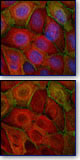
As a result of its super-optimized nutrient profile and PCT formulation, this fully defined medium offers both excellent isolation and extended growth of human mammary epithelium.
This defined medium can even equal or improve on the performance of traditional non-defined media, for example those containing Bovine Pituitary Extract.
The PCT formulation of CnT-27 is known to delay the onset of differentiation. Thus for experiments where cells are induced to differentiate, the culture should be switched to CnT-22 24-hours prior to the induction of differentiation.
The optimum seeding density for CnT-27 is 4x10^3 cells per square cm. If you are restricted to densities below 1x10^3 cells per square cm, then CnT-54 may provide improved isolation efficiency and growth rate.
CnT-22
With a super-optimized nutrient profile, CnT-22 may also be used for successful mammary epitehlium isolation in a defined environment. However for extended growth over many passages, isolation and culture in CnT-27 is recommended.
With its non-PCT formulation, CnT-22 is recommended for use in any experiments where mammary cells are induced to differentiate. See above for details.
CnT-54
Based on an optimal nutrient profile, CnT-54 offers the absolute best in vitro performance by combining all the progenitor cell retention benefits of PCT, with the growth boost of BPE.
In addition, the Low BPE formulation of CnT-54 contains 4-8x less BPE than alternative media, thus minimising any potential variability, and ensuring maximum accuracy and reproducibility in your experiments.
The optimal seeding density for CnT-54 is 2x10^3 cells per square cm, however this medium will also enable good isolation and growth at densities of 1x10^3 cells per square cm and below.